The weather most useful for a colorful sunset is not captured by a single “sunny” or “cloudy” icon. Look at where clouds are, how thick they appear and whether low sunlight can reach them. These are clues to investigate, not a guaranteed recipe.
Clouds can reflect warm light or block it
NOAA explains that clouds take on the color of the sunlight they receive near sunrise and sunset. Thick clouds can reduce or block transmitted sunlight and look gray. See NOAA: The color of clouds. This helps explain why a cloud-filled sky sometimes glows and sometimes stays subdued.
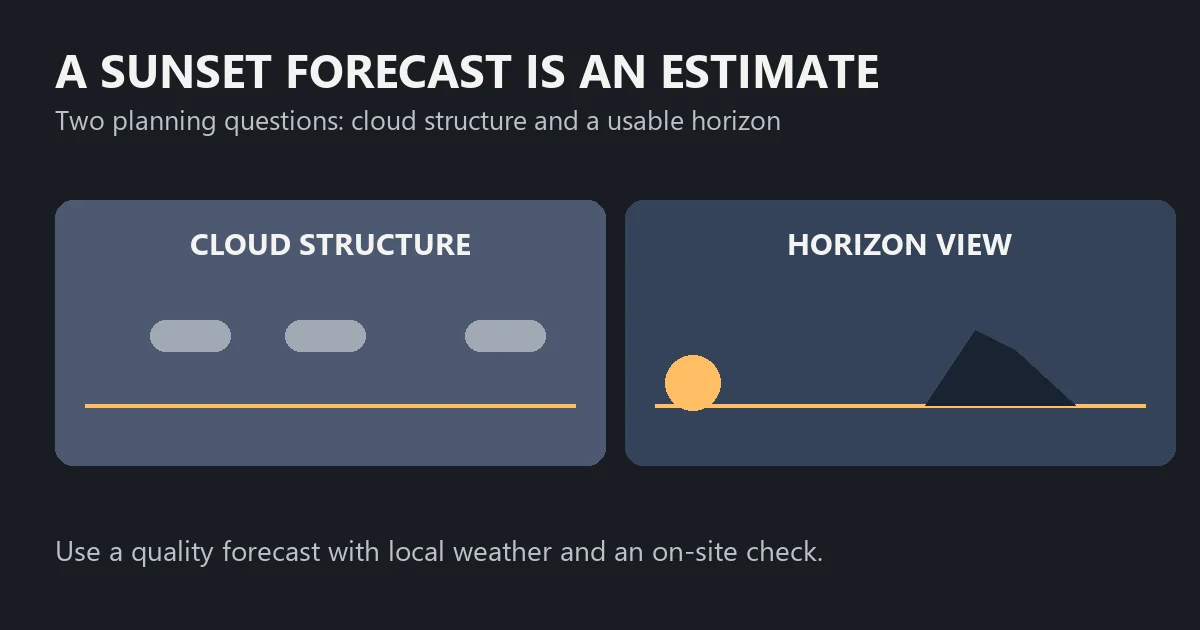
For planning, separate clouds over your viewpoint from clouds near the setting Sun. A visible opening at the western horizon is worth watching, even when much of the sky overhead is covered. Conversely, an interesting cloud pattern overhead may not become illuminated as you hope.
Look beyond total cloud cover
Different cloud types occupy different levels of the atmosphere; NOAA’s NOAA: Ten basic clouds is a useful visual reference. A total cloud-cover percentage cannot tell you the full arrangement of those layers. Do not infer an exact color outcome from that percentage alone.
Use the forecast to decide whether a trip is plausible, then compare it with the visible sky. If you have access to satellite imagery, check its timestamp and remember that a view from above does not show every detail of your horizon.
Use a local comparison checklist
- Is the western horizon open, partly covered or completely obscured?
- Are there distinct cloud shapes you would want in a photograph?
- Is the forecast changing during the hour around sunset?
- Can you move to a second nearby viewpoint without rushing?
- Would the foreground still make a useful photograph without strong color?
Do not confuse dramatic conditions with safe conditions
A visually interesting sky is not permission to remain exposed during hazardous weather. Review official warnings and choose a location with a straightforward exit. If conditions deteriorate, change the plan rather than prioritizing the last few minutes of light.
Be cautious with shortcuts such as assuming rain automatically produces a good sunset. The relevant question is what the sky and sunlight are doing at your location during that particular window.
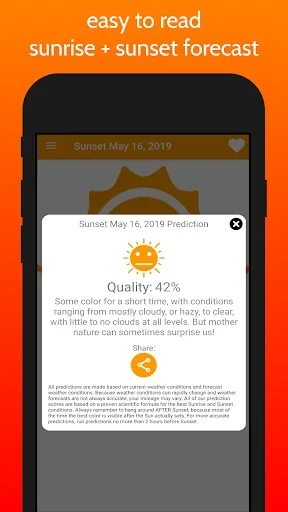
SkyCandy provides sunrise and sunset forecasting tools to support your decision. Pair a forecast with a repeatable prediction routine, and use golden-hour and blue-hour planning to leave room for photographs before and after sunset.