The International Space Station can appear as a bright moving point crossing the sky. Seeing it is primarily a timing and line-of-sight task: you need a visible pass for your location, an unobstructed route across the sky and weather that lets you follow it.
A station overhead is not always visible
A position on an orbital map is not the same as a visible sighting. NASA explains that its visible station opportunities occur around sunrise or sunset, when sunlight reflected by the station can contrast with a darker sky. Read NASA’s Spot the Station guidance to understand the difference between tracking the orbit and planning a sighting.
Select your actual observing location and check that the time is local. A pass listed for a different city or an old date is not a dependable plan. Look again shortly before the session rather than keeping a screenshot of an earlier schedule indefinitely.
Read direction and elevation together
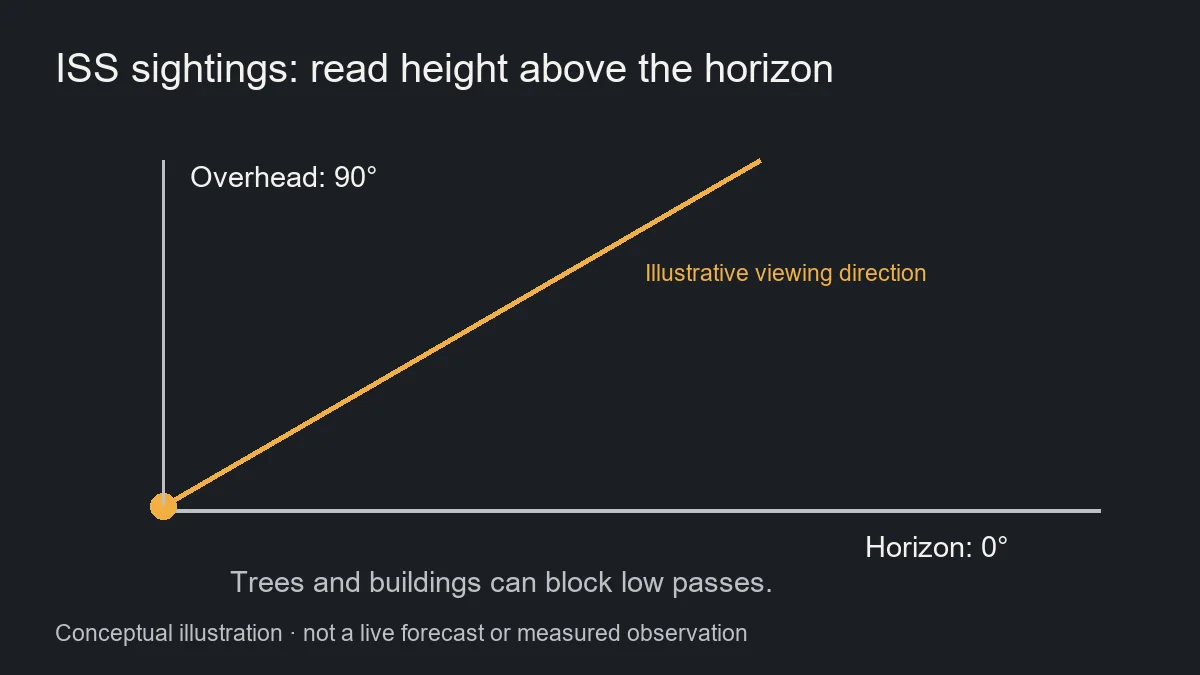
A sighting notice may describe where the station appears, where it disappears and its maximum height above the horizon. NASA measures that height in degrees: the horizon is zero and directly overhead is 90. A low pass can be blocked by a building or tree even when its predicted track crosses your general area.
Check both the starting direction and the route across the sky from the place where you will stand. Find a broad view before the pass begins. There is little benefit in arriving at the right minute and discovering that the whole first half of the track is behind a roof.
Use the ISS tools without overplanning the darkness
Light Pollution Map includes ISS tracking and flyover alerts, alongside sky-condition and astronomy tools. Use it to organize the pass and inspect weather for the session. Check current platform availability and alert settings in the app before relying on a notification.
For a bright visible pass, a nearby open viewpoint can be more convenient than driving to an extremely remote dark site. Darker surroundings may improve the experience, but do not substitute a dark-sky destination for the timing, Sun geometry and open horizon that the sighting requires.
Prepare before the predicted start
- Confirm the date, location and time zone.
- Identify the appearance direction using landmarks in daylight if possible.
- Check clouds along the full viewing window.
- Arrive with enough time to settle into the viewpoint.
- Follow the moving point across the predicted path without staring into the Sun.
For example, if a low western start is blocked from your garden, a legal nearby public viewpoint with that direction open may solve the problem. This is an illustrative access choice, not a prediction of a particular pass. Do not move onto roads or private property simply to preserve the view.
Questions about ISS sightings
Do I need a telescope?
Not for an ordinary visible pass. Start with the unaided-eye view; specialized high-magnification tracking is a different task from watching a moving bright point.
Why did the station disappear before reaching the horizon?
Its visibility depends on illumination as well as position. Use a current sighting prediction rather than assuming that every point along an orbital track will remain visible.
For another timing-dependent night outing, use our meteor-shower plan. If you also want to observe faint stars, check astronomical darkness separately from the station pass.
Explore Light Pollution Map on Google Play or Light Pollution Map on the App Store for current platform features and purchase options.