Astronomical darkness describes the part of the night after evening astronomical twilight has ended and before morning astronomical twilight begins. It is a useful planning boundary for faint-sky observing, rather than a guarantee that your location will look perfectly dark.
Sunset and darkness are different events
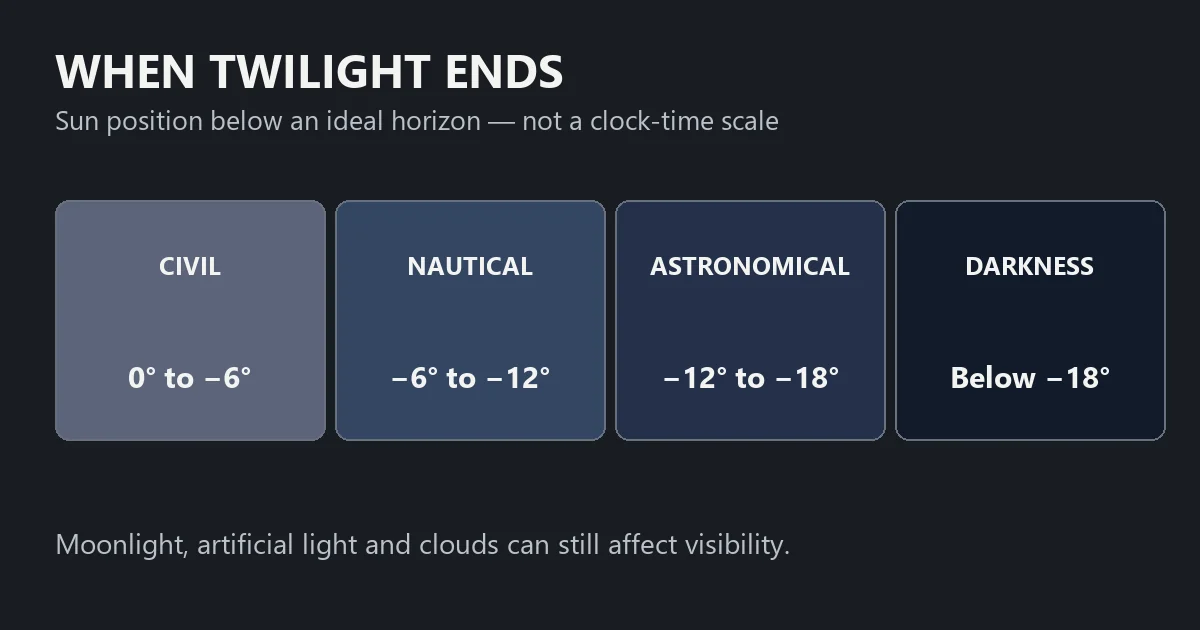
The US Naval Observatory defines twilight using the Sun’s position below the horizon. Civil twilight ends at 6 degrees below it, nautical twilight at 12 degrees and astronomical twilight at 18 degrees. Before morning astronomical twilight and after evening astronomical twilight, scattered sunlight is less than natural background illumination. See US Naval Observatory: Rise, set and twilight definitions.
This gives you a more precise question than “What time is sunset?” For an observing session, ask when astronomical twilight ends at your location and when it begins again the following morning.
Check the location, date and time zone
Use your observing location rather than a distant city. Verify the date and the time zone shown in the result, including daylight-saving time if applicable. A time copied from another location or season can lead to arriving much too early or too late.
The US Naval Observatory: Astronomical data services provide location-based Sun, Moon and twilight information. At some latitudes and seasons the Sun does not reach the astronomical-twilight boundary, so a conventional astronomical-darkness window may be absent. A calculator should show that condition explicitly instead of inventing a time.
Darkness still has other limits
Even inside that window, check Moon presence, clouds and local artificial lighting. Astronomical darkness removes one source of illumination from your planning question; it does not remove every other source. A nearby lamp can also interfere with your view regardless of the time.
Turn the times into an outing
- Write down the end of evening astronomical twilight.
- Check Moonrise and Moonset for the same location and date.
- Compare the hourly weather over your available session.
- Allow enough time for travel, parking and equipment setup.
- Set a sensible finishing time and plan the return route.
For example, if the darkness window begins after your park closes, the plan needs a different legal location. If clouds arrive soon after darkness starts, a shorter local session may be more useful than a long drive.
Explore Light Pollution Map’s stargazing tools and compare possible sites with our dark-sky planning guide. Use the twilight window as one part of a complete plan.