A photograph can look soft because moisture is forming on a lens, even when focus and camera stability seem correct. Condensation is a weather-and-equipment problem with two common situations: gear cooling outdoors and cold gear entering a warmer environment. Plan for both rather than repeatedly adjusting focus.
Read temperature and dew point together
Dew point is the temperature to which air must cool, under the relevant conditions, to reach saturation. The National Weather Service explains the difference between dew point and relative humidity in its dew-point guide. A small air-temperature/dew-point gap is a useful signal to investigate moisture conditions, not an exact timer for lens fogging.
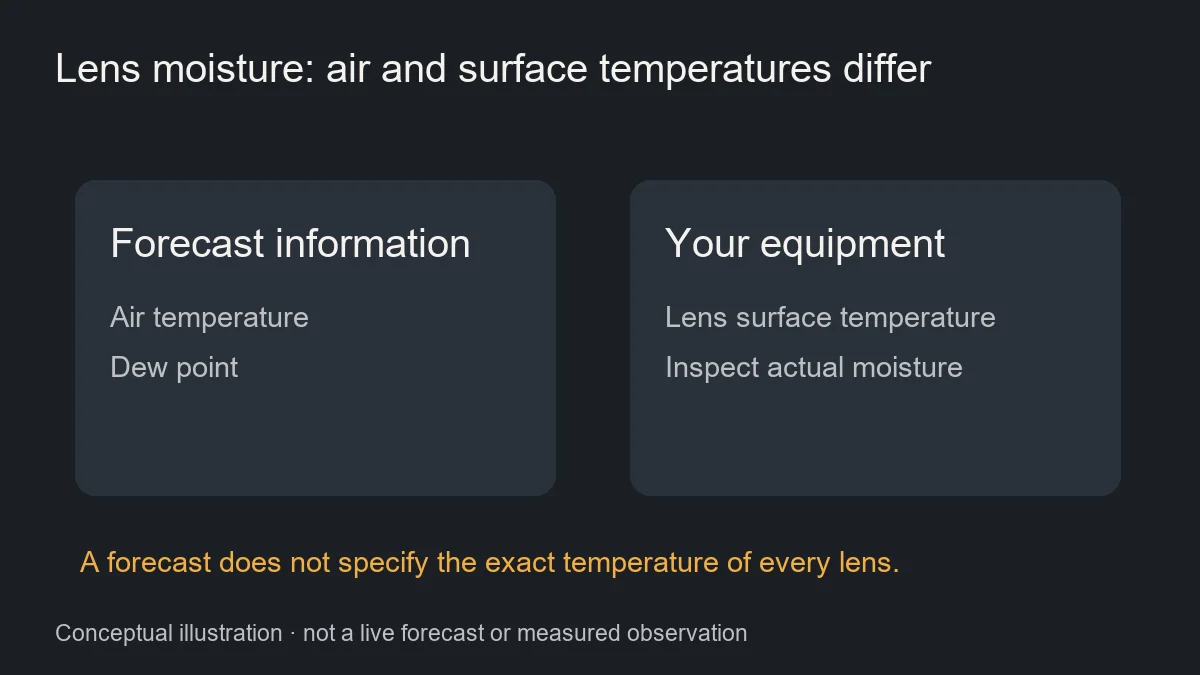
The lens surface has its own temperature. A forecast describes the air at a modeled location and time, so the displayed air temperature does not tell you precisely when every piece of equipment will become wet. Avoid a universal rule that a certain gap guarantees either condensation or a clear lens.
Inspect the image and the front element
If contrast falls unexpectedly, inspect the lens and any attached filter before changing multiple camera settings. Moisture can alter the image differently from ordinary defocus. Follow the manufacturer’s cleaning and drying guidance; wiping repeatedly while condensation continues does not solve the underlying temperature issue.
Prepare appropriate equipment care for the session length. If the conditions exceed your camera’s specified operating limits, change the plan. A weather-resistant label is not a promise that all combinations of camera, lens, accessory and temperature are suitable.
Treat the trip indoors as part of the session
Nikon’s product-care guidance warns about abrupt temperature changes and describes using a sealed bag or case before crossing a temperature boundary, then allowing adjustment. Apply your own model’s instructions rather than adopting another camera’s limits as universal specifications.
Prepare the bag before leaving the cold environment, not only after moisture appears in a warm room. Do not seal visibly wet equipment for long-term storage. If you suspect internal moisture or malfunction, stop and follow the manufacturer’s guidance rather than attempting disassembly.
Use a weather plan with inspection breaks
Fotocast combines photography weather, session planning and weather-aware gear suggestions. Use those verified tools to organize the session and remember the equipment you need. Where a forecast provides temperature and dew point, compare them for the intended hours; this guide does not assume every Fotocast platform exposes a dedicated condensation forecast.
For example, schedule a check after setup and another before the most important sequence. Include time for packing and adjusting gear when returning indoors. That is an illustrative care routine, not a guarantee that a fixed inspection interval prevents moisture.
Questions about lens fogging
Does high relative humidity always mean my lens will fog?
No. Surface temperature and the environment matter too. Read the moisture conditions and inspect the equipment rather than diagnosing from one percentage.
Is condensation the same as photographing atmospheric fog?
No. Fog in the landscape can be the subject; condensation on optics affects the equipment. Our fog-photography guide covers the first task, while this guide covers keeping optics usable.
Explore Fotocast on Google Play or Fotocast on the App Store for current platform features and purchase options.