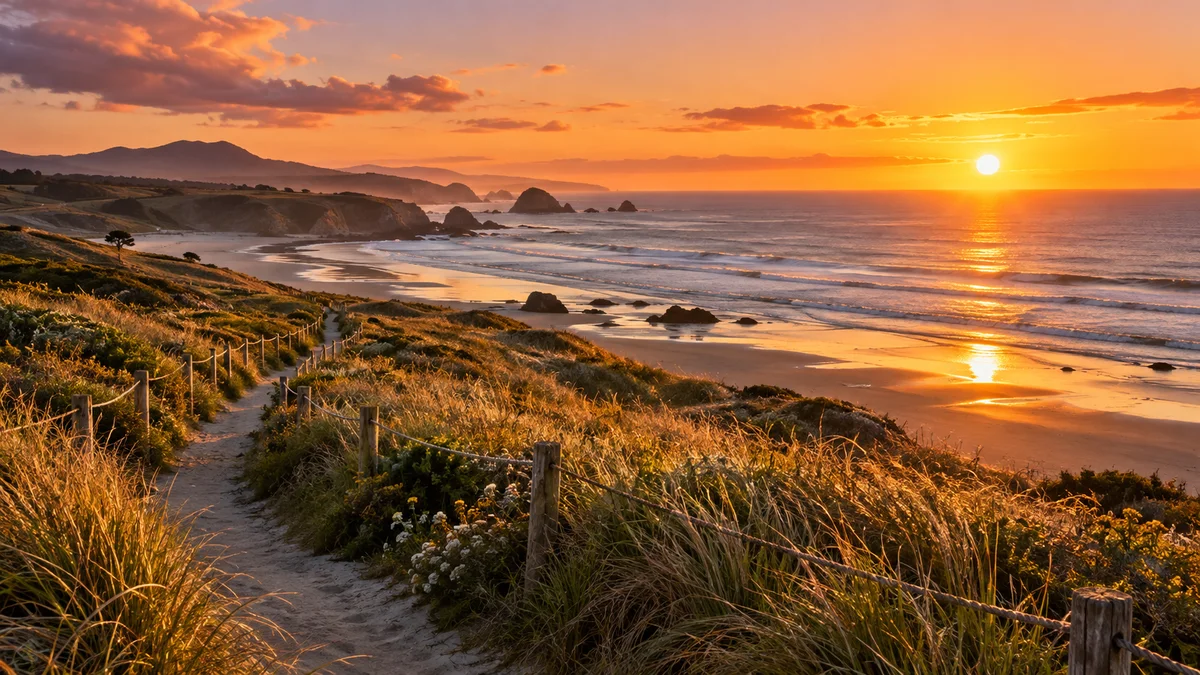
A viewpoint that catches the setting Sun in one month can miss it in another. “Face west” is a useful first approximation, but it is not precise enough for placing light beside a tree, across a building or along a shoreline. Plan the direction for the date and the place you will actually use.
Direction changes as the seasons change
Earth’s tilted axis changes the Sun’s apparent path through the year. NASA’s explanation of the seasons describes the underlying geometry. The practical result for photography is that sunrise and sunset do not stay at a single compass bearing all year.
Location matters as well as date. Avoid applying a northern-hemisphere rule to every place in the world, or assuming a daylight pattern from home will work during a trip. At high latitudes, some dates do not have an ordinary daily sunrise or sunset. Check the selected location before building a schedule around a familiar clock time.
Separate direction, elevation and forecast quality
Direction tells you where to face; elevation describes how high the Sun is. A quality forecast addresses another question: whether weather looks promising for a colorful event. A favorable sunset score cannot move the Sun into your composition, while a perfect alignment cannot guarantee colorful clouds.
SkyCandy offers sun-position and direction planning alongside daylight phases and sunrise/sunset quality forecasts. Use direction to investigate the composition, daylight information to organize arrival, and the forecast to choose between possible outings. Premium quality forecasts up to three days can support near-term planning; they are not a year-long weather prediction.
Scout a date and viewpoint together
- Choose a foreground that is reachable and legal to photograph.
- Set the location and intended date in the planning tool.
- Check whether the Sun’s direction suits the frame.
- Inspect nearby obstructions and the return route.
- Recheck the weather shortly before the outing.
For example, a pier photographed with side light in spring might have backlighting from the same camera position later in the year. Rather than force the old composition, try another legal position or a different date. Make a note of the viewpoint and season so the result becomes a useful plan for a future visit.
Account for the horizon you can actually see
A calculated sunrise or sunset uses assumptions about the horizon and atmosphere. NOAA’s solar calculation notes explain that observed events can differ from calculated times. A ridge, building or trees add a separate obstruction to the visible scene.
Arrive before the light you want. Treat the event time as an anchor, then allow for setup and terrain. A landscape photo often depends on side light or the clouds after the Sun leaves the frame, rather than the exact second of the horizon crossing. Follow your equipment’s guidance for photographing strong light; never look at the Sun through an optical viewfinder.
Questions about sun-direction planning
Is a compass bearing enough for a precise alignment?
It is a starting point. Local obstructions, your exact position and device orientation still need checking. Scout important compositions rather than relying on one number.
Should I choose direction or a sunset forecast first?
For a fixed subject, check geometry first. For a flexible sky-led outing, choose a promising event and then a suitable viewpoint. Our sunset silhouette guide shows one way to use that distinction.
Explore SkyCandy on Google Play or SkyCandy on the App Store for current platform features and purchase options.