A high sunset forecast can lead to a gray evening, while a low forecast can occasionally be followed by beautiful color. That does not make planning pointless. It means a prediction should help you choose an outing, rather than promise a particular photograph. The useful question is what you can check before leaving and what you can learn afterward.
Sunset time and sunset quality are different predictions
A sunset time is an astronomical calculation. A quality forecast interprets weather conditions. Knowing when the Sun sets cannot tell you whether clouds will catch warm light or whether the view from your chosen spot will be blocked.
Keep those decisions separate: first identify the time and direction of the event, then judge whether the weather and location suit the photograph you want. Our sunset prediction guide explains that planning workflow.
Weather forecasts begin with incomplete information
The Met Office explains that forecast errors can arise from uncertainty in the starting atmospheric conditions and approximations within the model. Small differences can lead to different outcomes. Ensembles explore several possible developments rather than assuming one simulation is certain. See the Met Office explanation of ensemble forecasting.
For a sunset outing, treat a forecast checked yesterday as an early planning signal. Check again before committing to a long drive. A change in the outlook is information to use, not a reason to keep following the original plan simply because you already chose it.
Cloud amount does not describe the whole view
Clouds take their color from the light reaching them; thicker clouds can reduce or block sunlight. NOAA’s explanation of cloud color describes why clouds can appear warm, white or gray. A broad cloud-cover number does not show you the exact arrangement of clouds and gaps in your composition.
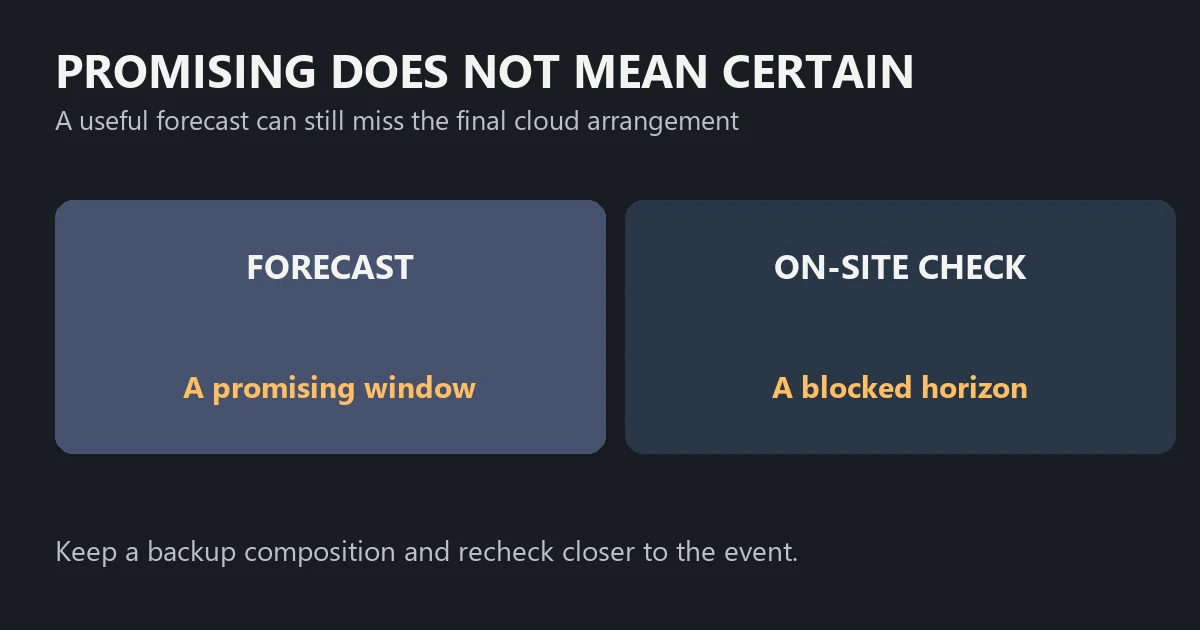
Look at the actual horizon when you arrive. A forecast for the area cannot move a tree, building or ridge out of your frame. If the Sun’s direction is blocked, a nearby legal viewpoint may be more useful than waiting in a spot chosen only for its forecast score.
A quality score is not automatically a probability
Do not assume an app’s 80% quality score means that eight out of ten evenings with that score must produce the photograph you want. A quality indicator and a calibrated probability of a precisely defined event are different things. Read the provider’s explanation rather than assigning your own meaning to its scale.
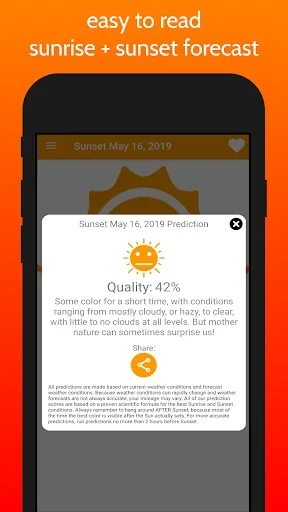
SkyCandy provides sunrise and sunset quality predictions to support planning. Its score is a forecast quality indicator, not a guarantee of colorful skies. Combine it with current conditions and a location that works for your intended composition.
Make the trip useful even without dramatic color
Illustrative example: suppose a promising forecast encourages you to visit a lakeside viewpoint. Before leaving, choose both a wide sky composition and a quieter reflection or silhouette. If the sky stays muted, you still have an achievable second subject. The example is a planning approach, not a forecast for any real location.
- Keep a nearby alternative that does not require another lengthy journey.
- Choose a return time before you leave.
- Use golden hour and blue hour as different creative opportunities.
- Record the forecast timestamp, viewpoint and result when comparing future outings.
Review several outings, not one disappointing evening
Write down what you wanted: saturated clouds, a visible Sun, warm foreground light or simply a pleasant sky. A forecast cannot satisfy all those goals equally. A short notebook of comparable outings helps you decide which signals are useful for your own routine, without turning one success or failure into a universal rule.