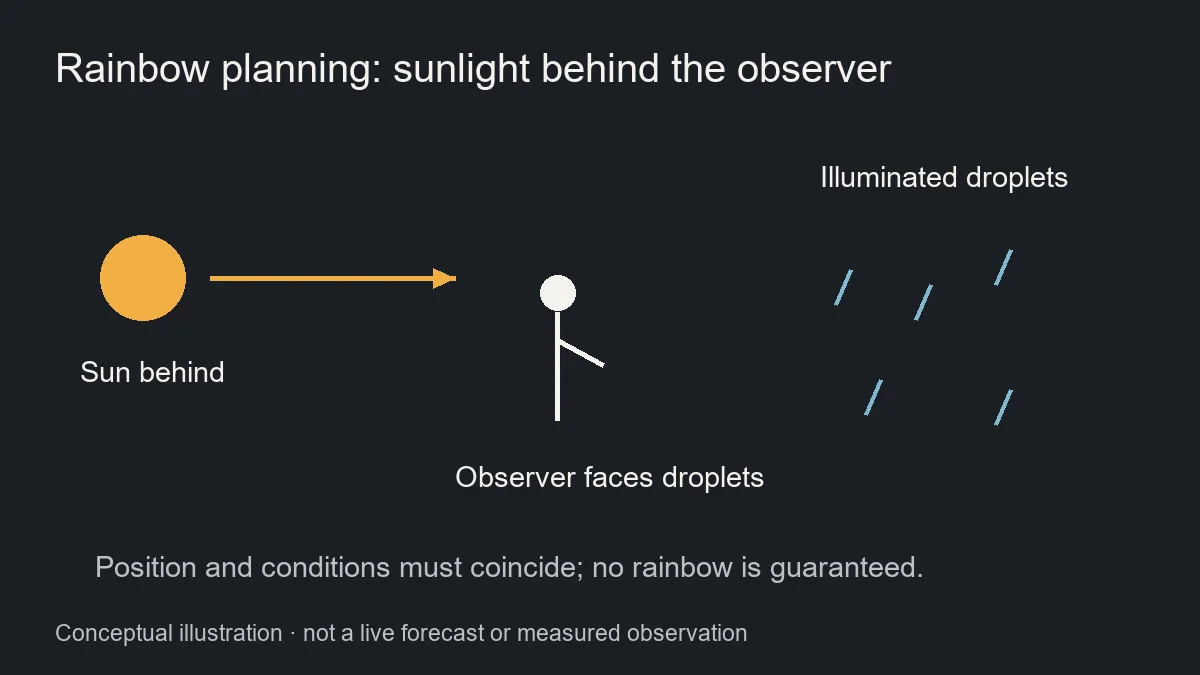
A rainbow photo starts by looking in the right direction while the right light and droplets overlap. A “rainy” daily forecast is not enough, and a colorful sunset forecast is not a rainbow prediction. Plan for a possible opportunity without making it the only reason an outing succeeds.
Look away from the Sun toward the droplets
NOAA explains that a rainbow depends on sunlight, airborne water droplets and the observer’s position. For an ordinary sunlight rainbow, the Sun is behind the observer and droplets are in the viewing direction. See NOAA’s rainbow explanation.
That geometry is useful when choosing a viewpoint. If the late-day Sun is in one direction, inspect the opposite sky for a rain curtain and a suitable foreground. Do not chase a mapped “end” of a rainbow as if it were an object fixed to a field or road.
Understand why Sun height matters
The National Weather Service explains that a higher Sun makes a smaller portion of an ordinary rainbow visible above the horizon. Its rainbow guide gives the underlying explanation. Lower Sun positions can therefore offer a different photographic opportunity, but droplets and unobstructed sunlight still need to coincide.
SkyCandy’s Sun direction and daylight-phase tools help you work out the light geometry around sunrise or sunset. Use the quality forecast for a separate sky-color plan, and save a viewpoint with an open opposite horizon. SkyCandy is not being presented as a dedicated rainbow forecast or storm-tracking tool.
Choose a foreground and a fallback
Scout a place where the expected viewing direction has a simple foreground: a field edge, a tree or an accessible stretch of townscape. Keep enough room in the frame for an arc to extend beyond the first colorful segment you notice. Take an initial usable frame before spending time on a more elaborate composition.
For example, a passing shower may leave rain in one direction while low sunlight reaches your viewpoint from behind. You could photograph the first visible segment, then widen the frame if the arc develops. This is an illustrative setup, not a forecast of a rainbow at any named place.
Check exposure and keep the session weather-aware
Inspect a test image for excessive brightness in clouds and for marks from water on the lens. Contrast and color adjustments should support the actual scene rather than turn a barely visible trace into an implied strong natural display. Avoid a fixed exposure recipe: the background can range from bright cloud to dark rain.
Rainbows can accompany weather that makes a location unsuitable. Follow official warnings and use a safe indoor fallback if thunder occurs; see the National Weather Service lightning guidance. Do not cross floodwater or move toward a storm for a better foreground.
Questions about rainbow planning
Can an app’s sunset quality score tell me a rainbow will appear?
No. The score concerns sunrise or sunset quality, not the specific combination of droplets, sunlight and viewpoint needed for a rainbow.
Where should I look during sunset?
For an ordinary sunlight rainbow, check opposite the Sun while suitable droplets remain illuminated. Use date-specific Sun direction planning rather than a fixed compass shortcut.
Explore SkyCandy on Google Play or SkyCandy on the App Store for current platform features and purchase options.