A useful dark-sky destination is more than a dark patch on a map. It needs a clear view, suitable weather and reliable access when you intend to visit. Start with a shortlist of nearby locations, then compare the conditions for a particular night.
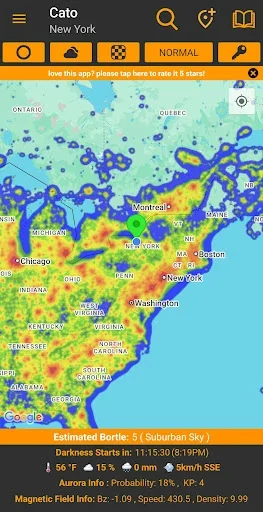
Use a light pollution map to narrow your search
Look beyond the bright center of your town and compare several reachable locations. A map is a planning aid, not a promise about tonight’s sky. A parking lot light, an obstructed horizon or cloud cover can make a promising location disappointing. Read how to interpret the Bortle scale before treating a map estimate as a measurement.
Choose a nearby option and a farther alternative. Compare travel time as well as darkness: the location you can reach and leave safely is often the more useful starting point. Save the actual observing spot, rather than only the name of a large park.
Check the Moon and the weather
The National Park Service recommends checking Moon phase when planning stargazing. Moonlight adds natural brightness, so also consider whether the Moon will be above the horizon during your session. See NPS: Stargazing 101. For faint targets, compare your observing window with astronomical darkness.
Review the hourly forecast for the observing location, not just the city you are leaving. Check clouds across the intended session and the return journey. Recheck before departure rather than relying on a forecast saved several days earlier.
Confirm access before going
- Check official opening hours, parking rules and any required permit.
- Confirm that nighttime access is permitted; a public daytime viewpoint may close after sunset.
- Identify a legal parking place and a walking route away from traffic.
- Check whether trees, hills or nearby buildings obstruct your target direction.
- Bring clothing, a charged phone and a light suitable for the return walk.
Compare what you actually see
Arrive early enough to find your position before the session starts. Avoid judging the sky immediately after looking at headlights or a bright screen. Record the date, Moon conditions, cloud cover and any intrusive local lights. Those notes make the next comparison more useful than an isolated map number.
Explore Light Pollution Map to compare potential dark-sky locations. Use it alongside official access information and current local weather, then keep a second location in reserve if conditions change.